How Wellbeing Initiatives Help to Attract and Retain Top Talent
How Wellbeing Initiatives Help to Attract and Retain Top Talent
A no-nonsense, BS-free interview with our founder, Emma-Louise Fusari
What’s ‘quiet quitting’ and is it still happening?
‘Quiet quitting’ means people are going to work, doing their job and then going home (or finishing) at the end of the working day. They’re not checking their emails outside work hours and they’re not doing any more than is absolutely necessary. It’s disengagement.
The term seems to have appeared after some guy’s video went viral on TikTok and then the media picked up on it as a new experience. But quiet quitting is not a new phenomenon.
There’s been some noise recently that 2023 has seen the end of it, particularly in tech. With reports of employees back to the hustle culture, working fifty-plus hours a week. I think it’s scaremongering due to the recent tech layoffs we’ve been hearing about in the news.
There’s a lot of negativity in the media about quiet quitting, describing these people as lazy and doing the bare minimum. But when an organisation has a great culture – and when an employer cares about its people – people will naturally give a bit more and want to help the business succeed. If people are quiet quitting, there’s a problem with the culture.
Following the pandemic, people started respecting their own boundaries and realising, that prioritising their health and wellbeing for work was an acceptable exchange.
How can organisations attract and retain talent?
The ‘great resignation’ was another term coined recently. Naturally, people look to grow their career and may need to move to a role not available in their current organisation. But, I think the pandemic worsened retention rates because people realised they don’t have to work in an environment that’s not good for them. A recent study by Deloitte found that 28% of employees in the UK either left their jobs in 2021 or were planning to leave them. More recent studies revealed nearly one-fifth of the UK workforce (19%) plan to look for new jobs in 2023.
All the things I spoke about before the pandemic – such as yoga, cycle to work, and fruit in the staffroom – people can see through them. There’s no point saying you’re a supportive employer who provides yoga or discounted gym membership when the manager’s a Cockalorum (Definition – a boastful and self-important person; a strutting little fellow). Businesses need to find the root cause of a problem.
Quite often businesses and leaders have good intentions. They want their staff to be healthy and happy which is really good, but the processes in which the business operates (the operational frameworks that they have) are often what make people miserable and unwell – and then they leave.
They may think, ‘We’ll do yoga – that will help wellbeing.’ But they need to first consider how problems are presenting in their business. Problems that relate to employee wellbeing will show in the business as a lack of productivity and disengagement.
There’s often a disconnect between what employers think is them doing a good thing for their people and what their people think is their employers doing a good thing for them. There’s a gap. That’s the problem with current initiatives. You know the common ones – mental health first aid training, yoga, cycle to work, sending people gift boxes – they’re not improving people’s health and wellbeing or getting to the root cause of the problem.
Employers need to get to the root causes of problems. Really addressing these problems will create happy and healthy workplaces that attract and retain talent. You might tempt talent with a generous salary, but if the culture isn’t right, they’ll move on quickly.
How can investment in wellbeing be more strategic?
Wellbeing is a strategic arm of the business. It’s not this nice thing to have.
You can’t afford to not invest in your workforce, so make sure you get a return on the money you do invest. If you’re not measuring the impact of wellbeing initiatives, how do you know you’re getting a return from your investment in them? When businesses are spending £300 on a yoga class and money randomly on something else, they could be investing it in something that will give them a real insight into the health and wellbeing of their organisation.
You make a significant investment in your people by paying high wages. Are you making an equivalent level of investment in the health of your people to ensure the money you’re spending on salaries is getting you the best return?
Happy and healthy people are essential for a thriving business and strong revenue growth. Your people are your business. Protect your investment in them.
Recent research shows that when people choose employers, money isn’t the only factor that’s important to them. It’s causing a crisis for some previously high-performing businesses.
It’s frequently something that comes out in my panel discussions.
People want a nicer environment. The way people perceive the role of the workforce has changed. How they want to be at work has changed. I think they’re a bit less tolerant.
For higher earners, a £10,000 raise equates to a real increase in take-home pay of £6,000. Many people would prefer to remain on their comfortable salary and instead enjoy the real benefits of a better work-life relationship. Money isn’t top of the list anymore. Actually, some people would prefer an employer that cares about them and genuinely wants to look after them. That additional pay isn’t always seen as the best way to enrich their lives – particularly if they feel their work is removing them from happy and fulfilled lives.
To retain those high-quality employees, businesses need to be a bit cleverer about how they’re spending that money. If companies can spend a lot on wages to attract high-performing people, they can maintain that high performance by spending money on the culture.
Our bodies aren’t designed to maintain levels of high performance for long periods of time. If people are working for long periods in a high-pressure environment, we need to teach them how to develop helpful coping strategies. These aren’t the same for everyone. It needs an expert view.
During periods of growth, organisations need to make informed decisions about whether to take on more work or hire new people. Often this evaluation doesn’t happen until too late, leading to a lack of skilled staff, burnout, delayed projects and slow growth.
If you work in digital tech, the risks to the health and wellbeing of your staff are phenomenal. You’re looking for an answer to a complex problem.
There are some startling statistics from the BIMA. They show that people who work in tech are five times more likely to be depressed than the national average. 66% of the workforce is stressed. These statistics are pre-pandemic too.
There’s also a large neurodiverse population within tech. It’s important to understand how different parts of your business communicate and operate with each other. How you communicate with your workforce and operate around them is key to your success. In-house Health can support you and advise your teams – to ensure you succeed.
What should an organisation do if it’s growing fast?
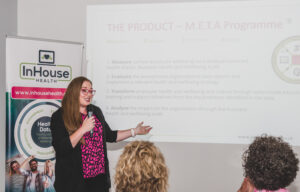
We’d recommend starting with your business health. The M.E.T.A Wellbeing Audit will tell us where you’re at from an operational point of view and what actionable strategies to implement next.
Supporting the health and wellbeing of new and existing teams is important. The M.E.T.A Wellbeing Audit will give you an idea of where you can put support in place as you go through growth for continued innovation and sustainability.
It’ll make sure people feel supported and give you effective communication throughout any periods of change.
Emma-Louise Fusari, Founder of In-House Health
P.S. Want to know what good looks like for your business? Schedule a call below to find out how⬇
https://calendly.com/inhousehealth/meta_audit