
Growth & Wellbeing – Have We Found the Recipe?
Growth and Wellbeing – Have We Found the Recipe?
Workplace health and wellbeing is a subject that is gaining popularity in the business world.
Sadly, for employees with underlying health problems, there’s a lot of confusion and a lack of understanding. Some employers are nervous about workplace health and wellbeing and don’t know what advice they should be listening to. Whilst others lack the time and expertise to implement workplace health and wellbeing at an organisational level.
Some studies imply that measuring business outcomes such as absenteeism, presenteeism and productivity are not significant enough on their own to build organisational change.
Perhaps if we mix a spoonful of organisational and economic performance with a measure of health and wellbeing. Add a sprinkle of aligning organisational beliefs and values. Mix it all together. We might just have made a valuable recipe for happier, healthier and more engaged employees and a strong business base from which growth can happen.
Let’s look at an agency that seems to have perfected the recipe!
You may be forgiven if you haven’t heard of the digital agency Dept. But only if you’re not in digital marketing!
 Founded in Amsterdam in 2016, the Dept team has grown from 150 employees in The Netherlands to more than 1500 Depsters worldwide (the name given to their employees)! Well on its way to becoming one of the global top players, Dept has acquired more than 15 agencies and grown its revenue by 500%.
This is no easy achievement, so why have Dept been so successful? Dimi Albers, Dept’s Global CEO, believes it’s to do with the company’s ownership structure. Remaining as one agency, with one brand. This unites their widely skilled teams, ensuring they are all aiming for the same goals.
This sounded too business-focused for me. Surely an agency with such rapid growth and continued success had to be more people-centred than that?
In-House Health predominantly works with UK agencies. So, I was curious as to whether workplace health and wellbeing experiences differed globally in this sector. Do employees experience the same or different problems at work? And are agencies in other countries doing things differently to address these issues? Can we learn anything from Dept?
Back in January, it seems like a lifetime ago. I visited Dept’s HQ in Amsterdam and met up with Sandra van Heeswijk, Dept’s Global Head of People.

We discussed workplace health and wellbeing, engagement, and culture at length. We also explored the issues faced by organisations in managing employee expectations and the problems that employees face. Throughout our conversation, stress and burnout among employees kept cropping up, as well as musculoskeletal-related complaints. Mental health is high on the agenda at Dept, with support mechanisms continually evolving to suit the needs of the workforce.
One thing is clear, no matter where your agency is in the world, the key workplace health problems appear the same!
According to BIMA’s Tech Inclusion and Diversity Report 2019 (British Interactive Media Association). If you work in the UK tech sector, you have similar stress levels to those working in the NHS (66%). You are also 5x more likely to be depressed compared to the UK average.
Similarly, with work-related musculoskeletal disorders. 6 million working days are lost in the UK each year. It would be interesting to find out what percentage of these lost days are related to agency life.
With so many contributing factors to work-related ill health, it’s hard for organisations to know where to start! You would think it would be to ask your employees how they are feeling and how you can help them, right? Well not according to The WOW Company’s Bench Press Report 2020. 23% of UK agencies surveyed said that they NEVER measure employee satisfaction or engagement, followed by 21% of agencies who only measure this annually.
Sandra has her fingers on the pulse here, measuring employee engagement bi-annually. As well as listening to what employees have to say, Dept also measures Workload, environmental and management support drivers and whether they are being cared for enough as an organisation. With an employee engagement score of 8.1, it’s clear to see why Dept have seen a reduction in absenteeism and stress-related absence.
But it’s more than just asking and listening, it’s about action and leading from the top down.
With geographical differences, Sandra is not fazed by this. Saying, “We try to offer the same benefits and initiatives to all employees. But we also respect and recognise that there are different needs in different areas.”
Some of the workplace health and wellbeing initiatives Dept have implemented include:
- Preventative Health Checks
- Preventative Lifestyle Coaching
- Team Sport Activities
- Massages
- Discounted Gym and Cycle to Work Schemes
- Provide Healthy Lunches
- Mindfulness Training
- Knowledge Sessions and Feedback Training
Sandra evaluates what works and what doesn’t and creates new plans each year to keep the teams engaged in their work and their health and wellbeing. Sandra explains, “the preventative coaching has been really successful for Dept. But it’s the personal attention and the personal approach that we take that makes the real difference”.
Looking after 1300 people, can’t all be a bed of tulips (see what I did there)! So, I asked Sandra what her biggest problems are when tackling workplace health and wellbeing and the reply was not surprising!
Sandra’s first problem is, “That we (Dept) cannot change how fast the company is growing, which affects the employees.”
Although I can see a growing agency is a nice problem to have and good for your organisational bottom line, managing workplace culture during this time may be extremely difficult. Especially with problems such as stress, burnout, and mental health that we identified earlier.
Sandra also spoke about the challenges of managing a new generation of employees and how to understand what suits their needs best. There’s no doubt been a shift in employee expectations over the past few years. People now expect their employers to provide an environment where they can achieve fulfilment, meaning and the ability to give back to society.
A new analysis by Deloitte (2020), identifies young people aged between 18 and 29 as the most vulnerable demographic in the workplace, as a result of poor mental health. What percentage of your agency team fits into this age range?
Whatever problems are thrown Sandra’s way, it sounds like when it comes to looking after their biggest asset, their employees, The Depsters are in good hands.
Thanks to Sandra for taking the time to answer my questions and show me around HQ. My hunch was right, it had to be more than just business outcomes. There had to be people at the core of what the company was doing and there certainly is!

Dimi Albers told Adweek, “We have been able to grow swiftly because we’ve grown smartly”.
And that sums it up for me, the real power of employee engagement. Healthy and Engaged employees want to perform well, they care about the company and their role within it and they work better because of it. Dale Carnegie says, “Organisations with high employee engagement outperform organisations with low levels of engagement by 202%”!
For the best results, you may want to weigh out your ingredients. Give your recipe and what you’re taking the opportunity to turn out great every time.
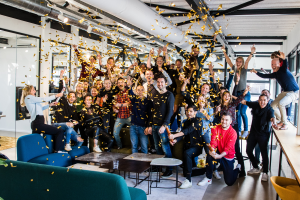
*On-location pictures taken by Vicki Head Photography 2020